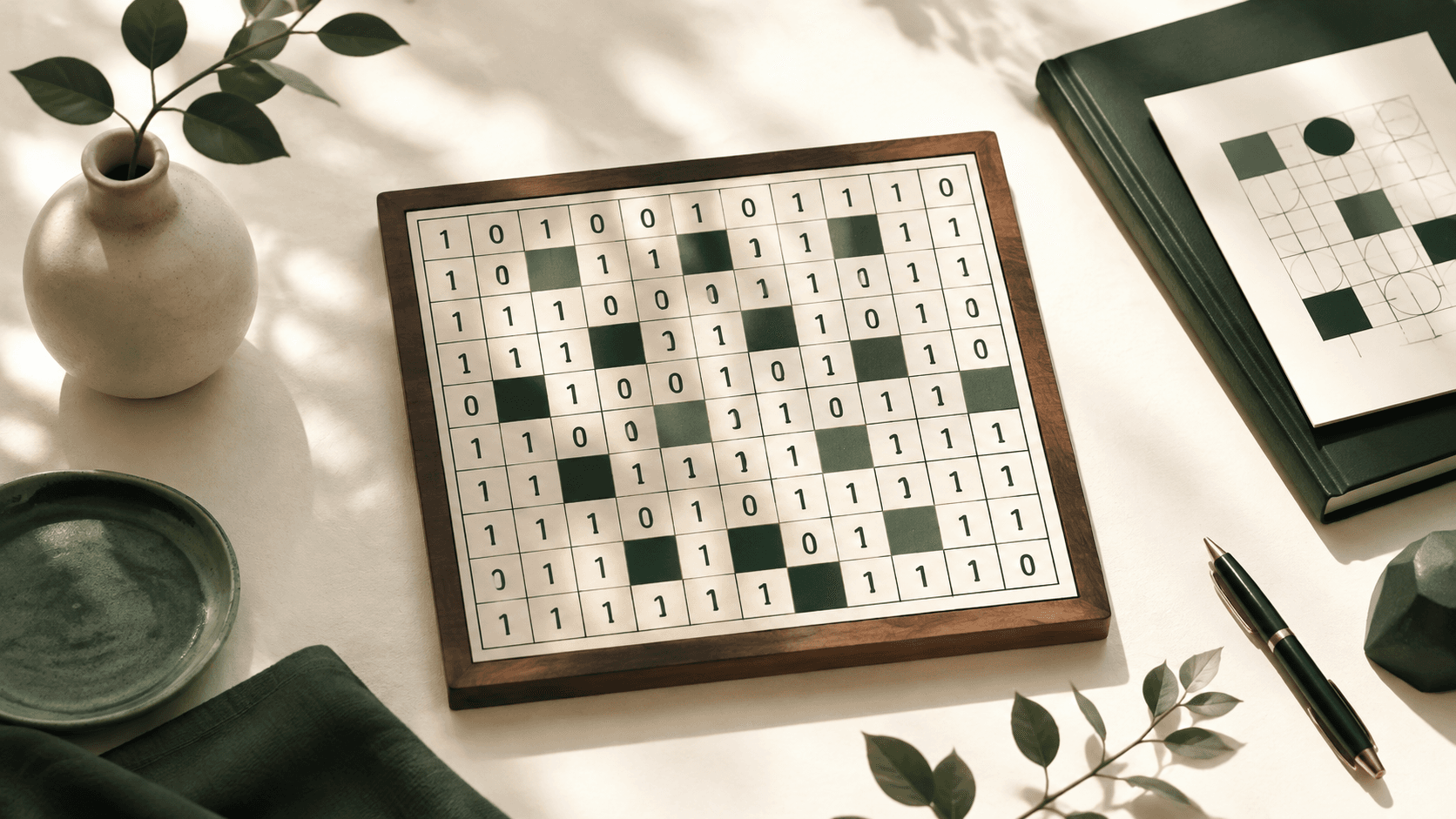
What the benefits of playing Binary Puzzle can realistically mean
A Binary Puzzle gives you a tightly defined problem: enter 0s and 1s while obeying balance, no-three, and uniqueness rules. Each move asks you to check a pattern, hold a constraint in mind, and decide whether a value is forced. That can make a short session feel absorbing and satisfying.
The most defensible benefits are practical and immediate. A grid can give you a focused break from open-ended tasks, a repeatable way to practise explaining a deduction, and clear feedback after every choice. Those are useful experiences, but they are different from proving that a puzzle prevents cognitive decline or improves every kind of thinking.
Research on cognitive training is helpful context, not a direct study of Binary Puzzle. It sets a careful expectation: people often improve at the task or cognitive skill they practise, while broad transfer to unrelated abilities is less reliable.
Why a Binary Puzzle can feel mentally demanding
The board is deliberately small, but its rules overlap. A row may be one digit away from balance, a nearby pair may forbid a triple, and a nearly completed line may have to differ from another finished line. Looking for the next forced move means switching between local cells and the larger row-and-column structure.
That process asks for sustained attention during the session. You keep a few facts active, compare alternatives, and check a conclusion against the grid. When a move is not forced, the honest response is to wait, inspect a crossing line, or test another rule rather than filling a square at random.
It is reasonable to enjoy that kind of concentrated practice. It would be a larger claim to say that every such session permanently changes memory, reasoning, or general intelligence. The research below is useful precisely because it draws that boundary.
What cognitive-training research can and cannot show
A 2018 systematic review of controlled cognitive-training trials in healthy older adults found moderate evidence for better performance in the trained domain, but not in other domains. The review also judged the evidence insufficient for preventing cognitive decline or dementia. That supports a modest interpretation: practising a structured mental task can sharpen performance related to that task, without proving a general medical benefit.
The long-running ACTIVE trial is a useful example of specificity. It studied structured memory, reasoning, and processing-speed training in older adults, with later booster sessions. At ten years, benefits were reported for the trained reasoning and speed areas, while the memory result was not maintained. It was a particular programme for a particular group, not evidence that every puzzle transfers everywhere.
A 2019 Cochrane review reached an even more cautious conclusion for computerised cognitive training in cognitively healthy older adults: the available evidence was limited and often low quality. These studies did not test Binary Puzzle itself. They show why it is more accurate to describe a puzzle as a worthwhile form of focused play than as a treatment or prevention tool.
A focused break with a clear boundary
Many daily tasks have no clean stopping point. Messages create more messages, research opens more tabs, and a large project can remain unfinished for days. A Binary Puzzle has a visible board, a fixed rule set, and a clear finish. That structure can make a short break feel more intentional.
The benefit here is not that the puzzle empties your mind. It gives attention one defined object. If you notice yourself scanning automatically, pause and name the rule that makes a cell possible. The small act of returning to the grid can be more satisfying than switching among several half-started tasks.
Practice explaining a conclusion instead of guessing
A strong Binary Puzzle move has a reason you can state. Perhaps two equal digits touch, so an open neighbour must be the other digit. Perhaps a row already contains its full quota of 0s. Perhaps one possible completion would duplicate a finished row. Naming the reason turns a placement into a small, checkable argument.
That makes the game especially useful for players who want to understand a solution rather than reveal it. When you make a mistake, do not only erase the cell. Trace the earlier assumption, identify which rule it overlooked, and try the scan again. The value is in the correction loop as much as in the completed board.
Use feedback and a reset to learn from a stuck grid
A puzzle gives immediate information when you check a move. On this site, the checker can identify a rule conflict, and Undo lets you return to the point where a chain began. That is more useful than treating every wrong answer as a failure. It lets you compare what you thought the rule said with what the completed line actually allows.
Try a simple reset when progress stops. Scan all rows for pairs, scan all columns for pairs, then count the lines close to balance. Only after those checks should you compare nearly complete lines for uniqueness. A fixed order reduces the urge to hunt blindly, and it makes it easier to notice what changed after a single placement.
Make a daily Binary Puzzle routine sustainable
A useful routine is small enough to keep. Start with a 6x6 board and finish it without a timer, or stop after one deliberate scan if time is short. The aim is to give each move an explanation, not to turn an enjoyable puzzle into another performance metric.
You do not need a universal schedule. A few calm sessions each week can be more meaningful than forcing a long streak that you resent. If a board feels too easy, choose a larger size. If it feels frustrating, return to a smaller grid and practise pairs, balance, and uniqueness one at a time.
Where puzzles fit in a broader brain-health routine
A puzzle can be one enjoyable part of a healthy routine, but it does not replace sleep, movement, social contact, medical care, or treatment for a health concern. The World Health Organization guidance on reducing the risk of cognitive decline and dementia considers broader lifestyle and health factors. It does not present a single logic game as a prevention programme.
That is a useful standard for any claim about logic puzzle benefits. Play because the grid is interesting, because it helps you practise a method, or because it gives you a defined break. If you are worried about changes in memory or thinking, discuss them with a qualified healthcare professional instead of relying on an app or puzzle for diagnosis or treatment.
Does playing Binary Puzzle make you smarter?
No single puzzle can justify that broad promise. Regular play can help you become more fluent with the rules, spot familiar line patterns, and explain Binary Puzzle deductions more quickly. Those are real forms of learning within the game. They should not be treated as proof of a general increase in intelligence or a guaranteed improvement in unrelated skills.
Can Binary Puzzle prevent dementia?
There is no direct evidence here that playing Binary Puzzle prevents dementia. Reviews of cognitive-training research have found limits in the evidence for broad outcomes and prevention. Enjoy the game for its own sake, and use established medical and lifestyle guidance when considering cognitive health.
How often should I play a Binary Puzzle?
Choose a pace you can enjoy and sustain. A short, attentive session several times a week may be more useful to you than rushing through a daily target. If you can describe why each move follows, the puzzle is doing the job you chose it for: giving you a clear, satisfying piece of logic to work through.
The useful benefit is a better way to spend a few focused minutes
Binary Puzzle is a compact logic game with enough structure to reward patience. Its strongest claim is simple: it can offer an engaging chance to focus, test a deduction, receive feedback, and finish something concrete. The science supports care with any larger claim.
Open a small board, look for one forced move, and explain it before you place it. That is a satisfying benefit without promising more than the evidence can bear.