Binairo vs Binairo Plus: check the rule switch first
Binairo Plus, often written Binairo+, keeps two familiar constraints: every row and column is evenly split between the two symbols, and three identical symbols cannot appear consecutively horizontally or vertically. On a 6x6 board, each line therefore needs three of each. The added clues sit between neighboring cells and constrain that specific pair.
The important switch is line uniqueness. Classic Binairo, Takuzu, and the Binary Puzzle game on this site forbid duplicate rows and duplicate columns. The Binairo+ version documented by Puzzle Binairo allows them. Read your publisher's instructions before using a deduction based on another completed line. The examples below use that documented Plus rule set.
Follow a sign chain from one known cell
Choose a consistent translation, such as white = 0 and black = 1, and keep it throughout the sheet. Here an underscore is an empty cell; spaces separate cells and signs. The x is a relationship marker, not a cell value or a multiplication instruction.
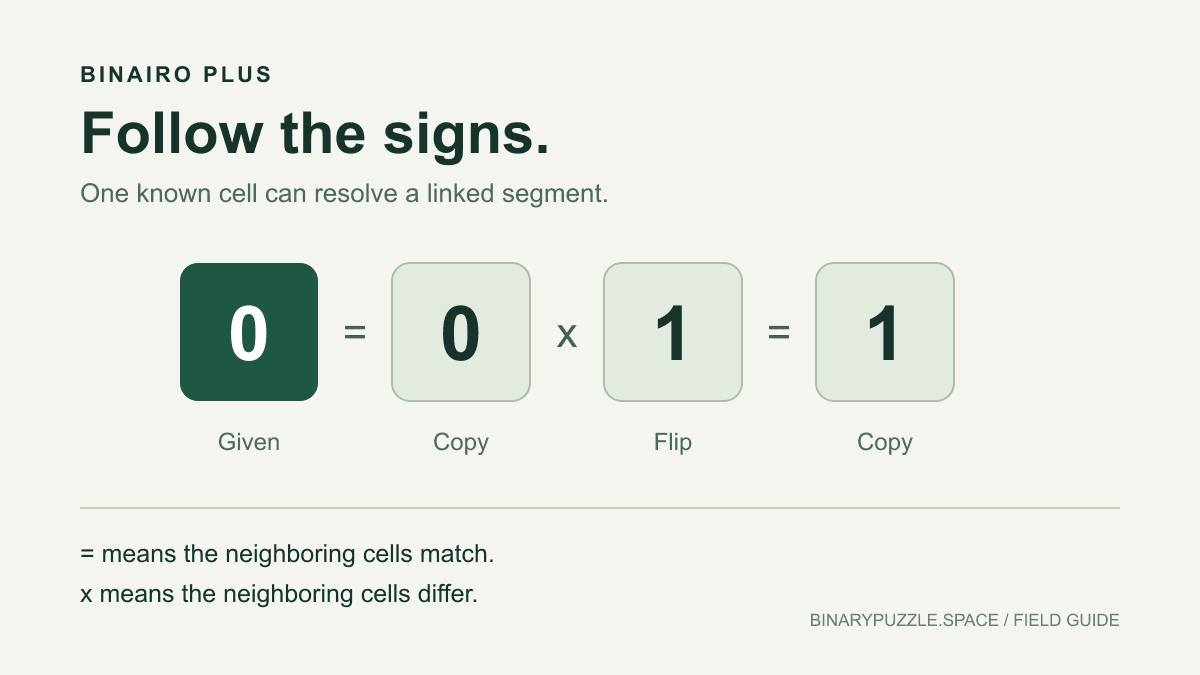
Start with the given 0 in this four-cell segment. The first equals sign makes its neighbor 0. The x changes the next cell to 1, and the final equals sign carries that 1 into the fourth cell. You now have 0011. Check the crossing columns after each placement, because a valid horizontal chain can still conflict with information above or below it.
You can follow the same clues backward or vertically. Copy across = and flip across x; neither sign has a direction.
0 = _ x _ = _0 = 0 x 1 = 1This is a four-cell segment, not a complete 6x6 row. The relationships determine all four values.
Know what a chain cannot tell you yet
Three empty cells linked by x and then x have only two arrangements: 010 and 101. The endpoints must match, but you cannot yet decide whether they are both 0 or both 1. A known crossing value can settle the orientation later. Until then, record the relationship rather than inventing a starting value.
Also check the shape of the chain. Three consecutive cells linked by two equals signs would become 000 or 111, violating the no-triples rule. If your notes imply that arrangement, revisit the signs and your entries. The same argument does not apply to an L-shaped chain: three matching cells around a corner are not three consecutive cells in one row or column. Keep the geometry visible while following the clues.
_ x _ x __ x _ x _Both 010 and 101 remain possible. The signs determine relative values, not an absolute starting color.
An unfilled = pair can constrain its neighbors
Suppose columns 3 and 4 of a six-cell row are joined by =, but neither is filled. If the pair becomes 00, columns 2 and 5 must both be 1 to avoid triples. If it becomes 11, those two neighbors must both be 0. Either way, columns 2 through 5 contain exactly two zeros and two ones.
That leaves columns 1 and 6 needing one of each. If column 1 is a given 0, column 6 must be 1, even though you still cannot choose the middle pair. The two legal row completions are 001101 and 010011. They share the endpoint values; their middle cells remain unresolved until crossing columns or other clues settle them.
0 _ _ = _ _ _0 _ _ = _ _ 1The = is between columns 3 and 4. Both possible pair values force column 6 to be 1.
Count an x pair before its colors are known
An x pair contributes exactly one 0 and one 1 to its line. You can include that contribution in the count before deciding which cell holds which value. Keep the two cells together while counting so you do not accidentally include them twice.
Take a row with known zeros in columns 1 and 3, and an x between columns 5 and 6. The known cells supply two zeros; the unresolved pair supplies the third. Columns 2 and 4 must therefore be ones. The final pair can still be 01 or 10, producing 010101 or 010110. Filling both middle blanks is justified; choosing an orientation for the final pair is not.
0 _ 0 _ _ x _0 1 0 1 _ x _Columns 5 and 6 contain one of each, so columns 2 and 4 must both be 1.
Use the remaining quota to orient an = pair
Now consider 0 1 0 _ _ = _, where the last two cells must match. The row already contains two zeros and one one. It has room for only one more zero, so the linked pair cannot be 00. Both cells must be 1. The remaining single blank, column 4, becomes 0, giving 010011.
This differs from ordinary count completion: neither symbol has reached its quota at the start. The useful fact is that an equal pair adds two copies at once. Compare that two-cell contribution with the remaining space for each value, then check for triples. On a larger board, use the appropriate half-row quota rather than automatically counting to three.
0 1 0 _ _ = _0 1 0 0 1 = 1The only valid completion is 010011: three zeros, three ones, and no triple.
Why duplicate rows can pass the Binairo Plus rules
Inspect this completed example. Each row has three of each digit. Down every column, the digits alternate, so every column is also balanced and triple-free. Rows 1, 3, and 5 match, as do rows 2, 4, and 6. Some columns repeat as well.
Those repeats are permitted under the documented Plus rules. For a concrete sign layout, place = between columns 1 and 2 and between columns 5 and 6 in every row. Place x between columns 2 and 3. Every displayed row satisfies those clues. The table illustrates a legal completed board, not a starting puzzle claimed to have one solution.
In our classic game, this same completed board fails line uniqueness. Do not carry a duplicate-row elimination from one version into the other.
- Publisher's illustrated help explicitly allows repeated lines
- How the classic Binary Puzzle uniqueness rule works
| 1 | 2 | 3 | 4 | 5 | 6 | |
|---|---|---|---|---|---|---|
| 1 | 0 | 0 | 1 | 0 | 1 | 1 |
| 2 | 1 | 1 | 0 | 1 | 0 | 0 |
| 3 | 0 | 0 | 1 | 0 | 1 | 1 |
| 4 | 1 | 1 | 0 | 1 | 0 | 0 |
| 5 | 0 | 0 | 1 | 0 | 1 | 1 |
| 6 | 1 | 1 | 0 | 1 | 0 | 0 |
A short routine when a Binairo Plus puzzle stalls
Scan the relationships before comparing whole rows. An unresolved pair may already contribute enough information to finish a different part of its line. Keep any uncertain orientation separate from a value you have actually proved.
Practice the differences without mixing the games
Can the same row appear twice? Yes, in the Plus rule set used here, provided all counts, adjacency constraints, and marked relationships hold. Can two adjacent cells match without an equals sign? Yes. A blank boundary does not mean x; only a printed marker imposes that extra restriction.
To rehearse, cover the answers in the three six-cell examples and write the reason for each forced value before filling it. Your targets are column 6 in the middle-pair example, columns 2 and 4 in the x-pair example, and all three blanks in the final equal-pair example.
For classic practice, open our 6x6 Binary Puzzle and choose Easy. It uses unique rows and columns and has no relationship markers. Practice balance and no-triples there; use a publisher's Binairo+ board for the sign-specific deductions.