Compare cells, lines and boxes
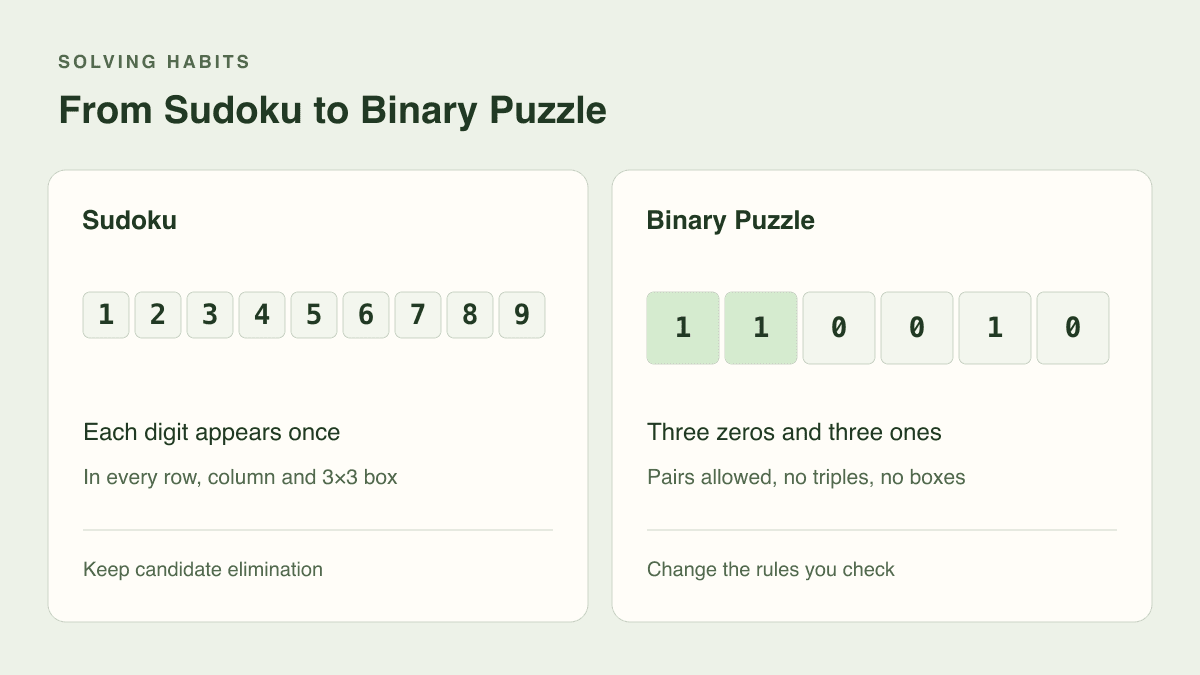
We checked Nikoli's standard Sudoku rules against the classic rules published by BinaryPuzzle.com. In standard 9x9 Sudoku, each row, column and marked 3x3 box contains the digits 1 through 9 once each. In a classic Binary Puzzle, each cell holds 0 or 1. A six-cell line needs three of each; an eight-cell line needs four. Adjacent pairs are allowed, while three identical consecutive digits are forbidden horizontally and vertically.
The word unique also changes what you inspect. Binary Puzzle requires each completed row to differ from every other completed row, and each completed column to differ from the other columns. Compare entire sequences. Standard Sudoku already makes two identical completed rows impossible through its column constraints.
For a Binairo vs Sudoku comparison, check the rules of the particular Binairo variant. This guide concerns the classic game on our site. A puzzle labeled binary Sudoku also needs that rule check before you reuse any Sudoku techniques.
| What you inspect | Standard Sudoku | Classic Binary Puzzle |
|---|---|---|
| One cell | One digit from 1 to 9 | One of two values, 0 or 1 |
| A full line | Each digit appears once | Half zeros, half ones; repeated digits expected |
| Adjacent cells | Equal digits conflict in a shared line | Pairs may match; triples may not |
| A marked region | Every 3x3 box uses all nine digits | No boxes or quotas for small regions |
| Two full rows | Check individual cells through columns | Also compare the complete row patterns |
| A proposed move | Eliminate alternatives using constraints | Keep this habit; apply binary constraints |
Allow repeated digits within a line
Your first adjustment is to keep a candidate even when that digit already appears elsewhere in its row. Consider this original six-cell example. The three visible ones have filled the row's quota, so the blank must be 0. The pair of ones at the beginning is legal.
The finished row, 110010, has three of each value and no run of three. Its repeated zeros and ones are required by the balance rule. A Sudoku-style scan that crosses out every value already present would remove both candidates and falsely declare the blank impossible.
That row has passed its own line checks. Its cells must still fit their crossing columns, and another completed row cannot copy the entire sequence. Keep those checks separate when explaining your move.
1 1 _ 0 1 01 1 0 0 1 0There are already three ones. The missing zero repeats an existing digit legally.
Stop searching inside Sudoku boxes
The second adjustment is to stop treating a small rectangle as a Sudoku region. Here is the upper-left two-row, three-column excerpt from a valid classic 6x6 solution. It contains four zeros and two ones, which is allowed. Balance applies to each full six-cell row and column.
The ones at R1C3 and R2C1 share this rectangle but occupy different rows and columns. Neither rules out the other. Any thicker styling or imaginary dividing line gives you no extra constraint in this game.
When a blank sits near a 1, name the exact relationship before eliminating anything. Does placing another 1 complete a horizontal or vertical triple? Does it exceed the full line's quota? Sharing a small region supplies no reason by itself.
| 1 | 2 | 3 | |
|---|---|---|---|
| 1 | 0 | 0 | 1 |
| 2 | 1 | 0 | 0 |
Keep elimination and crossing-line checks
Eliminating an impossible candidate works just as well here. In the three-cell segment 0 _ 0, a middle 0 would make 000, so the middle cell must be 1. This proof uses the no-three rule and works whether the segment lies across a row or down a column.
Your other useful Sudoku habit is to revisit the crossing line after a placement. Suppose a six-cell column reads 1 0 _ 1 _ 1. Its three ones require zeros in both blanks. Each new zero may form a pair in its own row, giving you somewhere specific to look next.
Two candidates do not justify a coin toss. The segment 0 _ 1 permits either 001 or 011 under the no-three rule. A crossing column or a full-line count must provide more evidence. On paper, leave the cell empty while considering both possibilities. Our game has no editable pencil-note mode, so pencil marks belong on your paper.
Choose a first practice board
Open our 6x6 page and select Easy in the difficulty controls. The small grid keeps the three-per-line counts manageable. The homepage's larger daily challenge can wait until these checks feel familiar. A smaller symbol set alone tells you little about which game you will find harder.
Before each entry, say what rejects the other value. After placing it, inspect the crossing line. When you stall, press Hint and read the explanation before using Place. Check reports visible rule conflicts; a clean result does not certify that every entry matches the answer.
For your first session, aim to explain five placements. If you catch yourself scanning imaginary boxes, return to the row and column of the selected cell. Finish one Easy board with reasons you can follow, then try another before increasing the size.
Sources and rule scope
The comparison uses standard 9x9 Sudoku and classic Binary Puzzle rules. The worked examples are original illustrations of those constraints. Variants can change the rules, so check their instructions before applying this table.