Prepare a small board and two kinds of counters
Set out squared paper, a pencil, and counters in two colors. Label one color 0 and the other 1; the digits should stay visible if the colors are hard to distinguish. Draw six boxes in a row for the warm-ups, then a 6x6 grid for the shared puzzle. Keep the answer below covered while you work.
Start when the child can count to three, follow a row with a finger, and explain a simple same-or-different choice. Those observable skills are more useful than a fixed age recommendation. Plan a brief session with permission to stop after one successful row. Finishing all 36 cells is a later goal, so a slow first attempt does not need to become a race.
Explain the task without teaching binary arithmetic
Here, 0 and 1 are two symbols to arrange. The child does not need to convert numbers into base two, add digits, or decode a secret message. If they have seen binary-code worksheets, make that distinction before starting.
Say the three rules aloud: each six-cell row and column needs three of each digit; three identical digits cannot touch in a straight horizontal or vertical line; completed rows must all differ, and completed columns must all differ. Move a finger down a column while explaining it. Diagonals do not count, and a row may match a column. Keep this rule card beside the paper.
Warm-up one: ask what the other value would break
Put two 1 counters down with one empty box between them. Ask the child to try a 1 in the gap and read the three boxes aloud. They have made 111, so that choice fails. Replacing the middle counter with 0 gives 101. This is a three-cell segment, not a complete row; you are practicing the no-three rule alone.
Repeat with two 0s, then rotate the paper so the same segment runs vertically. Before writing, ask which two known cells support the answer. If the child points to a diagonal, straighten the paper and trace the actual column together.
1 _ 11 0 1Only the middle box is being solved. Filling it with 1 would create three consecutive ones.
Warm-up two: count a complete six-cell row
Now show the row below. Let the child touch each 0 once while counting. There are already three, so both blanks must be 1. Have them count again after filling the boxes: three zeros and three ones, with no triple. A spare counter placed above each counted cell can help prevent counting one twice.
Then point to two different blanks and ask whether a blank means zero. It does not: it means the value is still unknown. Keep empty boxes empty until a rule decides them. This avoids a common teaching mix-up when children use zero to mean nothing.
0 1 0 _ 0 _0 1 0 1 0 1Every six-cell line needs three of each digit. Both remaining cells must be ones.
Check different rows by comparing every position
Write a completed row, 001101, on a separate strip. Below it, write 0 _ 1 _ 0 1. The two blanks need one 0 and one 1. Choosing 0 then 1 would copy the completed strip exactly. Choosing 1 then 0 gives 011001, a different balanced row without a triple.
Slide the strips together and compare one position at a time. Similar rows are allowed; identical completed rows are not. Do not reject two unfinished rows just because their visible clues match. For columns, turn both strips vertically. This mini-exercise teaches comparison separately before it joins the full-board checks.
Coach the first row, then let a column supply the next clue
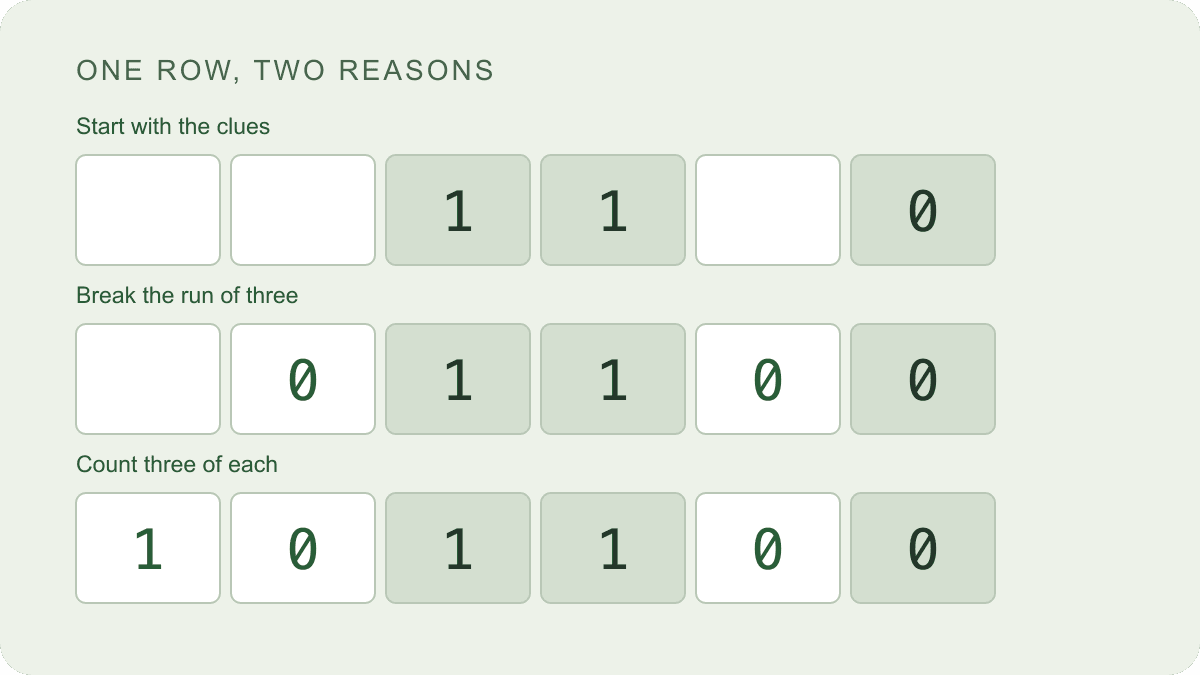
In row 1, the adjacent ones in columns 3 and 4 force zeros in columns 2 and 5. That leaves three zeros already present, at columns 2, 5, and 6. Column 1 must therefore be 1, completing 101100. Let the child place the counters while you name the supporting cells.
Next, inspect column 3. Its row 1 and row 3 entries are both 1, so R2C3 must be 0. In row 2, columns 1 and 3 are now both 0, forcing R2C2 to be 1. The row has all three zeros, so R2C6 becomes 1. Stop prompting and invite the child to find another pair.
Give partners different jobs and a way to pause
For two children, assign a finder and a checker. The finder points to a blank and proposes a value with a reason. The checker traces the relevant row or column and tests the rejected value. Swap jobs after each accepted move. One pencil stays with the finder, preventing simultaneous entries that neither partner can explain.
When they stall, ask them to count one named line or inspect one three-cell window. If that still feels difficult, return to a warm-up. When an error appears, erase the latest unsupported pencil entry and reconsider it together. Leave circled clues intact. End the session when attention fades; save the paper for another attempt.
Use the answer as a coordinate check
Reveal one cell at a time only after asking for the child's reasoning. Matching the answer without a reason does not explain the move. When the board is finished, count each row and column, scan for triples, and compare completed lines. This answer belongs to the printed lesson grid above, not to a randomly generated online game.
| 1 | 2 | 3 | 4 | 5 | 6 | |
|---|---|---|---|---|---|---|
| 1 | 1 | 0 | 1 | 1 | 0 | 0 |
| 2 | 0 | 1 | 0 | 0 | 1 | 1 |
| 3 | 0 | 0 | 1 | 0 | 1 | 1 |
| 4 | 1 | 1 | 0 | 1 | 0 | 0 |
| 5 | 1 | 0 | 1 | 0 | 0 | 1 |
| 6 | 0 | 1 | 0 | 1 | 1 | 0 |
Finish with three questions, including one without an answer
Before starting another board, show three short tasks. First, ask for the missing digit in 1 _ 1. Second, return to the six-cell counting warm-up and ask why both blanks are ones. Third, show only 0 _ 1 and ask whether its middle digit is decided. Both 001 and 011 avoid a triple, so this segment alone cannot settle the blank. Accept leaving it empty as the correct response.
Listen for evidence in each explanation: two matching neighbors, three zeros already counted, or two options still available. If the child answers correctly but cannot show why, repeat that task with counters. If they can explain all three, let them lead the opening of the next small board. Record which task needs another demonstration rather than a score or a fastest time.
Move to online practice after the child can explain a move
For a free binary puzzle for kids online, open our 6x6 page and select Easy. Demonstrate selecting a blank and entering 0 or 1, then hand over control. Use Undo for an accidental entry. If you use Hint, read its explanation together before pressing Place. Choose an untimed learning goal, such as explaining three moves, even though the game displays a timer.
For a classroom paper session, the printing guide explains how to print starting clues and download an existing worksheet. Use the lesson above when you want everyone discussing the same coordinates.